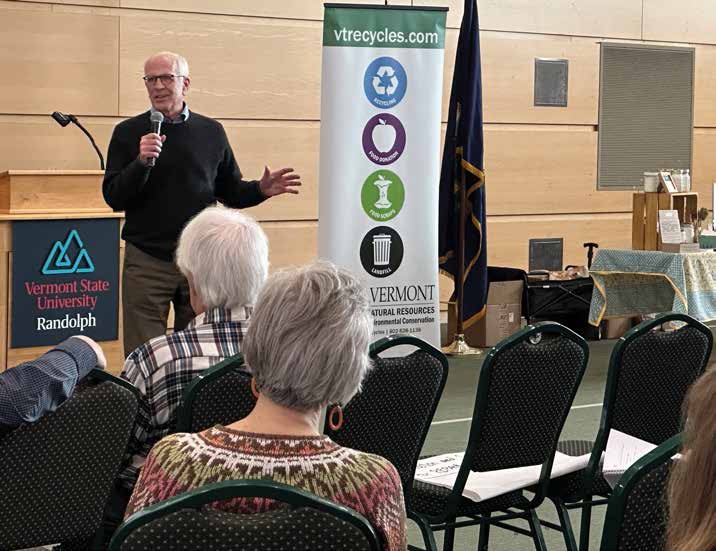
Sen. Peter Welch showed up at Vermont State University’s Randolph Center campus last Thursday with a pitch for federal legislation that would give farmers the legal right to fix their own equipment, no dealer required.
The visit was part of ReuseVT’s first-ever ReuseApalooza conference, a daylong event at the campus that blended a repair fair, a “drop and swap” exchange, and workshops on cutting waste. Welch didn’t open with farm policy. He talked about his own shopping habits first, telling the crowd he hunts for used clothes online. “I’m not kidding, you get good deals,” he said. Then he turned to the economic squeeze Vermont farmers are actually living with.
The bill he’s pushing is the FARM Act, formally the Freedom for Agricultural Repair and Maintenance Act, which Welch introduced last October. It would force equipment manufacturers to hand over software tools, parts, and repair documentation to farmers and independent technicians. Right now, that’s not happening. A farmer who’s dropped several hundred thousand dollars on a tractor can’t legally run diagnostics on their own machine when it breaks down. They can’t call an independent shop. Welch said the situation is blunt: “They have to call the dealer. They have to wait till the repair [person] comes out, and they have to have it repaired on site, and that costs some time. It could be a harvest season, and honestly cost a lot of money.”
The timing of the conference wasn’t lost on anyone in the room. Just days before Welch spoke, reports surfaced that John Deere had agreed to pay $99 million to settle a class action lawsuit brought by farms and farmers who alleged the company locked them out of independent repair. The Federal Trade Commission filed its own separate suit against Deere in 2025, claiming the company deliberately steered farmers toward its dealer network and inflated what they paid for parts and labor. Welch framed the settlement as proof, not background noise.
Vermont’s own right-to-repair efforts have hit a wall more than once. State bill H.81 cleared the House with 22% of members in opposition, came close, then died in the Senate in 2024. Lawmakers brought the concept back through H.161, the Vermont Fair Repair Act, introduced last year. State Rep. Monique Priestley, D-Bradford, co-sponsors the bill and, as reported by VTDigger, put the argument plainly: “Vermonters shouldn’t have to ask a corporation’s permission to fix what they own.”
That’s not her only repair bill in 2026. Priestley is also sponsoring H.160, which would extend repair rights to medical devices, including hospital diagnostic equipment. The logic isn’t different from the tractor argument: when manufacturers control who can fix a machine, they control the price and the timeline. In healthcare settings, that timeline can matter in ways it doesn’t when a combine sits idle. Vermont’s medical device market is small, but the Upper Valley’s geography, sitting next to Dartmouth Health and DHMC, makes the policy question harder to dismiss as abstract.
The through-line connecting the FARM Act, H.161, and H.160 is the same idea Priestley put into one sentence. People who own things should be able to fix them. The manufacturer’s business model doesn’t override that. Welch’s federal push and Vermont’s state-level efforts don’t move in lockstep, but they’re aimed at the same gate. John Deere’s $99 million settlement, the FTC’s 2025 lawsuit, the death of H.81, the revival through H.161: the fight’s been going on long enough that the politics have shifted. What was a niche consumer protection argument a few years back has found its way into a senator’s stump speech at a repair fair in Randolph Center on a Thursday in spring 2026.
Written by
Dartmouth Independent StaffContributing writer at The Dartmouth Independent
View all articles →