Cell service in downtown Hanover and parts of the Dartmouth College campus remains unreliable, prompting frustration from residents, students, and local officials. Despite recent efforts to expand Wi-Fi capabilities, the town continues to lack the infrastructure for consistent wireless coverage, especially in areas where cell signals are blocked by buildings or distant from major towers.
Nolan Love, a visitor to Hanover, recently experienced the issue firsthand when weak 3G service delayed his attempt to pay for parking on Main Street. “That’s kind of unacceptable for a college town,” he said, after spending eight minutes waiting for his transaction to process.
Students and residents describe spotty connections that vary block by block. Marga Camara, a student at Dartmouth’s Tuck School of Business, said it is often “basically impossible” to get service near her classes. Camara uses T-Mobile, and while she can sometimes get reception along Main Street, she regularly loses signal near Tuck Mall.
The problem affects people using various providers, often depending on their service plans or data prioritization. Jennifer Opalinski, who works in the Upper Valley and visits Hanover frequently, noticed degraded performance since switching from Verizon to Spectrum. “It just depends where I am,” she said. Spotty reception even with two bars of 5G means she can sometimes make calls or send emails but struggles with other tasks.
Robert Houseman, Hanover’s town manager, said the issue is widely recognized, including by town officials themselves. He lives near the intersection of Greensboro Road and Great Hollow Road, where he has no cell coverage at home. Even in portions of downtown, signals drop. “We are doing everything we can to remedy the situation,” he said.
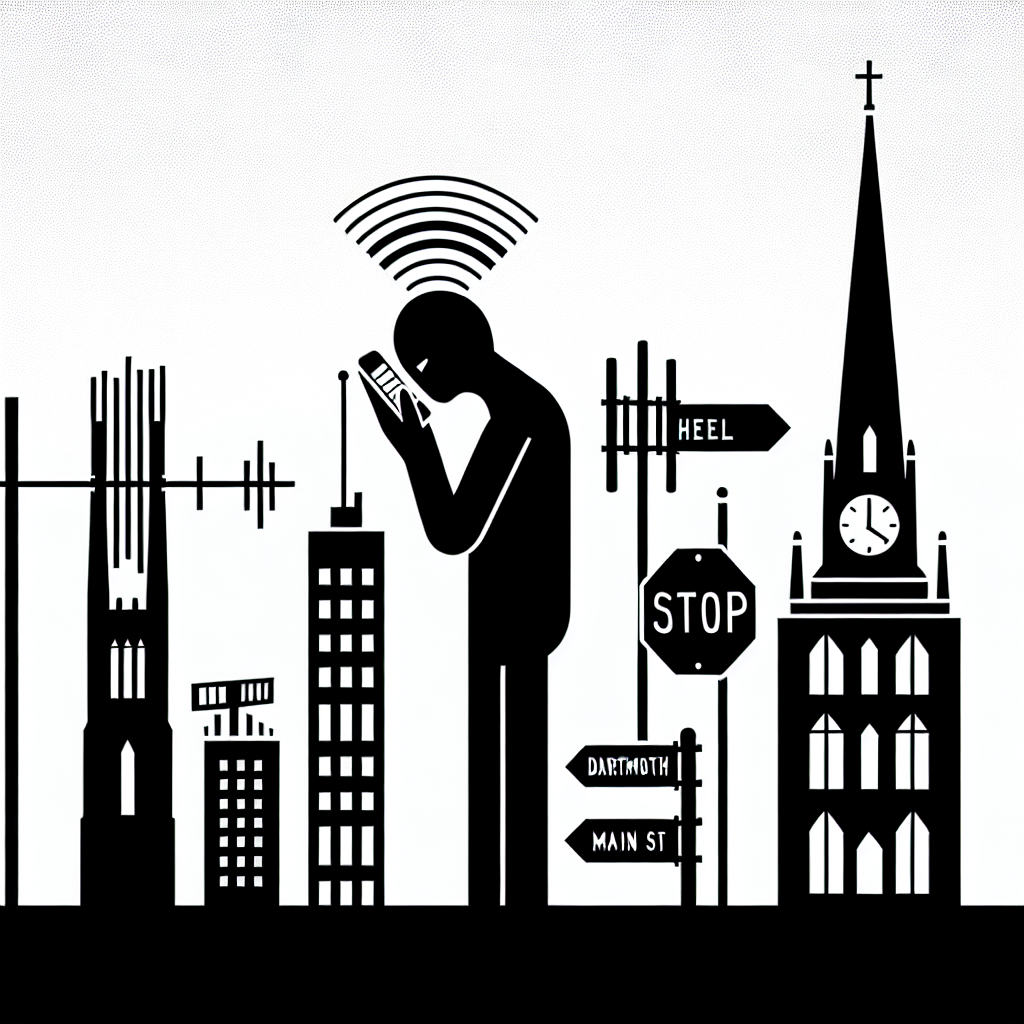
One of the central challenges is the town’s current tower infrastructure. The closest downtown cell antenna is in the steeple of the Church of Christ on College Street, approximately 70 feet above ground. According to Houseman, the tower is too short to cover large areas, as buildings interfere with signal transmission. Additional 5G towers are located at Dartmouth Hitchcock Medical Center and Moose Mountain, 4.5 and 6 miles away, respectively.
While newer generations of wireless technology like 5G offer faster data speeds, they also use higher frequency bands that do not travel as far. This has led to smaller coverage areas, which urban architecture in Hanover further limits.
Both the town and Dartmouth College have taken steps to improve internet access using local Wi-Fi installations. Dartmouth recently installed Wi-Fi along the Dartmouth Green that supports calls and cell data. Hanover later extended that system by placing antennas on town buildings. Current sites include the Town Hall, Lou’s Bakery, and Bank of America. These allow for Wi-Fi calling, a workaround for those with poor reception.
However, a broader fix, like a new, taller tower, has proven more difficult. The town approached Verizon about installing a temporary mobile tower, known as a C.O.W. (Cellular On Wheels), at the municipal parking garage. Such equipment is typically reserved for emergencies, and Verizon declined the request.
In July, Hanover commissioned three companies to assess coverage gaps. One firm completed a study free of charge, identifying a preferred location for a future tower. Houseman declined to disclose the site but said the next step is persuading wireless service providers to participate. “Now I gotta get the providers to say yes,” he said.
Verizon, T-Mobile, and AT&T did not respond to requests for comment.
As Hanover works with private tower companies, Dartmouth College, and Dartmouth Health to build out infrastructure, many residents and visitors remain caught in unpredictable coverage zones. Until a more scalable solution is in place, workarounds like public Wi-Fi and network resets continue to be common strategies.
For now, officials remain in talks, hoping to align public need with commercial investment in Hanover’s wireless future. The cell service issue is one of several infrastructure challenges facing Hanover, which has also been grappling with a contentious policing ordinance debate and has seen residents affected by the regional drought conditions.